Polices
- 1. Peer Review Process
- 2. Research and Publishing Ethics
- 3. Use of AI
- 4. Rejection
- 5. A Few Key Points
- 6. Third-party copyright permissions
- 7. Plagiarism Policy
1. Peer Review Process
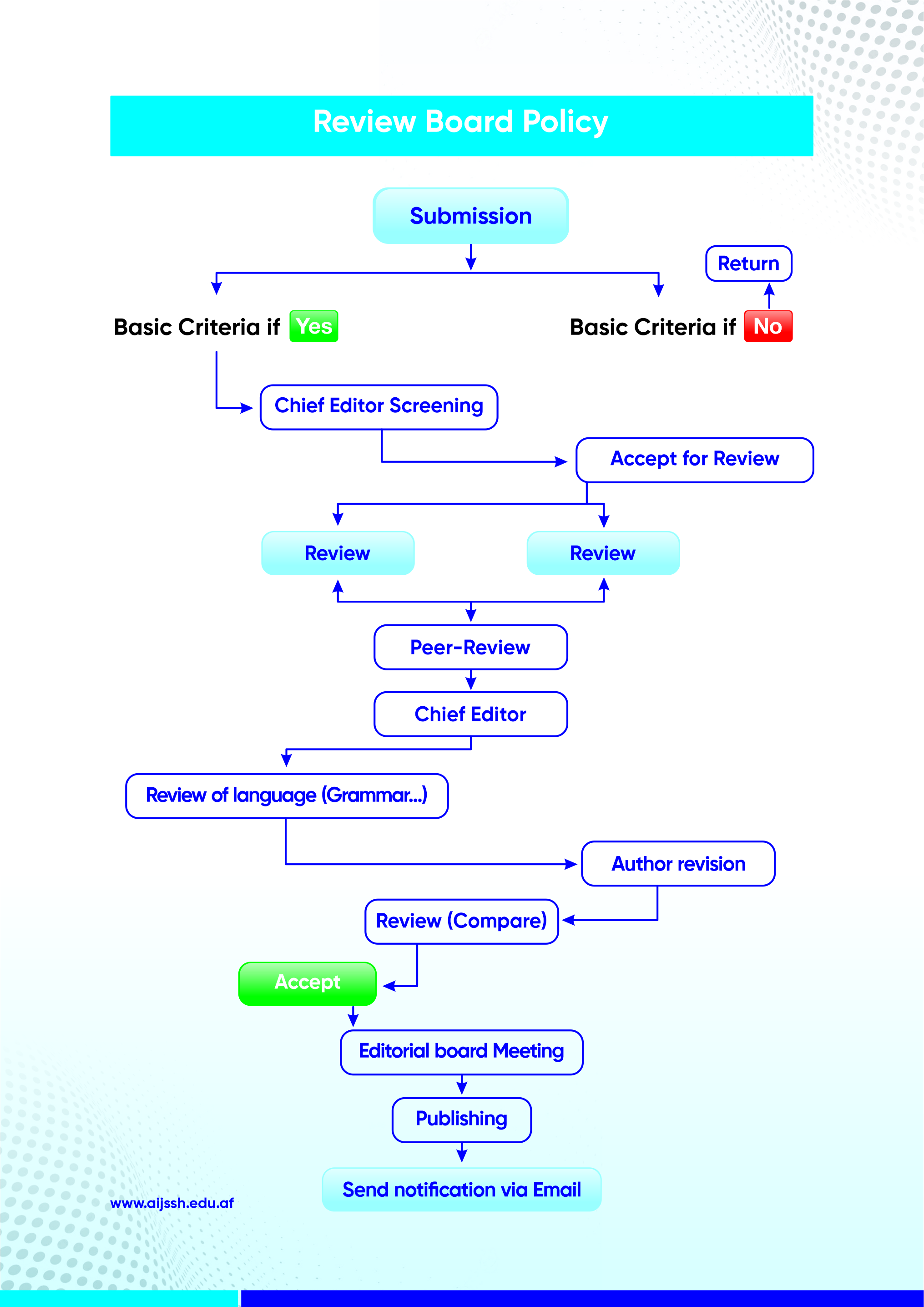
The journal uses a double-blind peer review process, which means that both reviewer and author's names are concealed throughout the review process. To facilitate this, authors need to ensure that their manuscripts are prepared in a way that does not reveal their identity.
2. Research and Publishing Ethics
Our editors and employees work hard to ensure the content we publish is ethically sound. We encourage authors to follow the academic rules and regulations in their writings.
Guidelines of the Committee on Publication Ethics (COPE)
Integrity: All submissions must be free from fabrication, falsification, or plagiarism.
Transparency: Authors, reviewers, and editors must disclose potential conflicts of interest.
Fair Review: Peer review should be objective, confidential, and respectful.
Corrections: Journals must issue corrections, retractions, or expressions of concern when errors are found.
Misconduct Handling: Allegations of misconduct (e.g., plagiarism, unethical research) must be investigated following COPE flowcharts.
Authorship: Only those with substantial contributions should be listed as authors.
Expectations for Reviewers on Participant Characteristics
During peer review, reviewers should check whether:
Participant demographics (e.g., age, gender, ethnicity, socioeconomic status, education) are clearly reported.
Inclusion/exclusion criteria are transparent.
Sampling methods and recruitment are described.
Limitations regarding generalizability are acknowledged.
Language used to describe participants is respectful and bias-free.
3. Use of AI
Authors must be transparent about the use of Artificial Intelligence tools such as Chat GPT and other large language models in the manuscript preparation, and disclose details of how the AI tool was used within the "Materials and Methods" section.
4. Rejection
During the pre-review evaluation, Editors-in-Chief or Subject Editors of AIJSSH check the manuscript and decide whether it enters peer review or is outright rejected. At this point, they may reject a manuscript prior to sending it out for peer review, specifying the reasons. The most common ones are non-conformity with the journal's focus, scope, and policies, and/or low scientific or linguistic quality.
In case the manuscript is suitable for the journal but has to be corrected technically or linguistically, it will be returned to the authors for improvement. The authors will not need to resubmit the manuscript, but only to upload the corrected file(s) to their existing submission.
5. A Few Key Points
- Any manuscript you submit to AIJSSH should be original. Exceptions to this rule are pre-print and conference papers. If any substantial element of your paper has been previously published, you need to declare this to the journal editor upon submission.
- Please note that the journal editor may use Turnitin to check on the originality of submissions received.
- Your work should not have been submitted elsewhere and should not be under consideration by any other publication.
- If you have a conflict of interest, you must declare it upon submission; this allows the editor to decide how they would like to proceed.
- By submitting your work to AIJSSH, you are guaranteeing that the work is not in infringement of any existing copyright.
6. Third-party copyright permissions
Prior to article submission, you need to ensure you’ve applied for and received written permission to use any material in your manuscript that has been created by a third party. Please note, we are unable to publish any article that still has permissions pending. The rights we require are:
- Non-exclusive rights to reproduce the material in the article or book chapter.
- Print and electronic rights.
- Worldwide English-language rights.
Please take a few moments to read our guide to publishing permissions to ensure you have met all the requirements, so that we can process your submission without delay.
7. Plagiarism Policy
Respecting intellectual property rights is a foundational principle of the AIJSSH Codes of Ethics. Plagiarism, in which one misrepresents ideas, words, computer codes, or other creative expressions as one's own, is a clear violation of such ethical principles. Plagiarism can also represent a violation of copyright law of Afghanistan, punishable by statute.


 Address: Shahbobo jan Street, Shar-e-Now, Kabul, Afghanistan
 Phone: +93 (0) 20 2201279
 Email:
  Email:
  Email:
  Working Time: 8:30 AM to 4:00 PM